
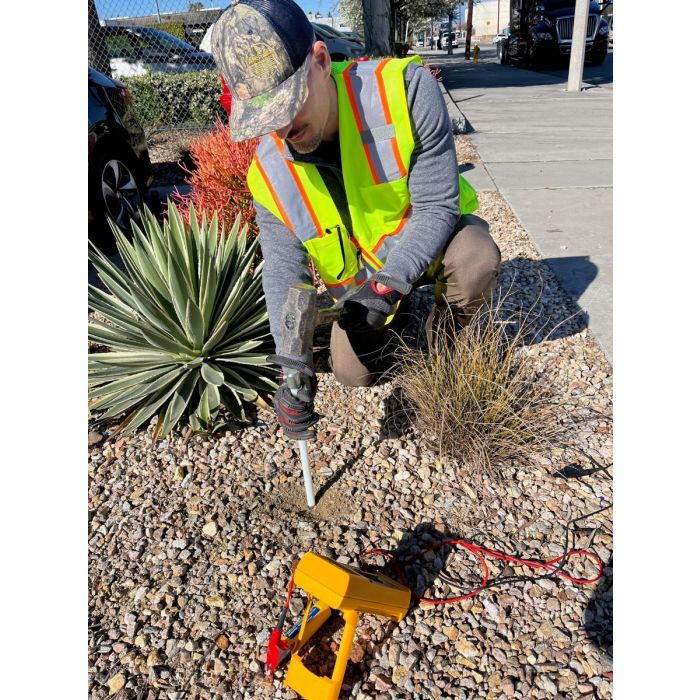
AC-10 Portable AC Current Density Coupon / Probe
- SKU#: 04-32150
- The AC-10 is a portable steel coupon/probe that measures AC current density on demand, without the cost of a permanently installed coupon. Driven into the soil like a soil pin, its replaceable 10 cm² conical tip converts milliamps directly to A/m² and gives a reading within seconds.
Attachments

-
Induced AC on pipelines is a potential shock hazard to personnel as well as a source of corrosion damage. Current technology to detect and monitor induced AC includes portable or permanent reference electrodes to measure voltage, and buried current density coupons to measure levels of AC current density. Monitoring current density, rather than AC voltage alone, is a key factor in assessing AC-related corrosion risk.
A simple and effective method of determining current density is to install a steel coupon of a known surface area in the soil adjacent to the structure. Connecting that coupon to the pipeline through a current measurement shunt or meter allows the induced AC current density to be calculated.
The Problem With Permanent Coupons
Until now, only permanently installed AC current density coupons have been available. The cost to install them can run to thousands of dollars per site once materials, planning, permitting, mobilisation, equipment and labour are counted.
The AC-10 Approach
The Farwest model AC-10 portable steel coupon/probe answers that problem. Used much like a portable reference electrode and similar in form to a soil pin, it is driven into the soil and functions as a permanent AC current density coupon would. Because it is portable, the AC-10 lets a CP technician measure AC current density on demand, or as part of a normal pipeline corrosion survey.
Product Features
- Durable steel construction.
- Multiple cable connection options.
- Replaceable 10 cm² conical tip for soil contact.
- Simple to use — AC current density readings are achieved within seconds.
-
Operation
The conical tip of the AC-10 must be in good contact with the soil to obtain an accurate measurement. Once it is, the current density measurement is taken with a digital multimeter and wire connections to the coupon/probe and the pipeline.
Because the probe is 10 cm², the conversion from milliamps to amperes per square metre is direct, with no arithmetic required.
Example: 25.0 mA measured = 25 A/m² AC current density.
Specifications
Farwest Item No. 04-32150 Surface Area 10 cm² conical tip Tip Replaceable; spare tip included Material Durable steel construction Cable Connection Multiple connection options Measurement AC current density via digital multimeter Conversion Direct mA to A/m², no calculation required Reading Time Within seconds of good soil contact Deployment Portable — driven into soil, no permanent installation -
What’s Included
The model AC-10 (Farwest item #04-32150) comes complete with the following.
- AC-10 coupon/probe with cable connection points.
- Spare 10 cm² conical tip.
- Hardened steel drive-pin for creating a pilot hole in hard soil conditions.
- Operating instructions.
Documentation
Contact Farwest Corrosion at (310) 532-9524 or submit a quote request.
-
Frequently Asked Questions
How is the AC-10 different from a permanent coupon?
A permanent AC current density coupon is buried at a fixed location and can cost thousands of dollars per site once materials, permitting, mobilisation and labour are included. The AC-10 is driven into the soil wherever a reading is needed and recovered afterwards.
Why 10 cm²?
At 10 cm² the measured milliamp value converts directly to amperes per square metre. A reading of 25.0 mA is 25 A/m² with no calculation.
What do I need to take a reading?
A digital multimeter and wire connections to the coupon/probe and the pipeline. The conical tip must be in good contact with the soil for the measurement to be accurate.
What if the ground is too hard to drive the probe?
A hardened steel drive-pin is supplied for creating a pilot hole in hard soil conditions.
Is the tip replaceable?
Yes. The 10 cm² conical tip is replaceable and a spare is included with every AC-10.
Why measure current density rather than AC voltage?
Monitoring current density rather than AC voltage alone is a key factor in assessing the risk of AC-related corrosion on a structure with induced AC.
How long does a reading take?
Once the tip is in good contact with the soil, readings are achieved within seconds, which makes the probe practical during a normal pipeline corrosion survey.